How does a homeowner get started harvesting rainwater and what applications can the water be immediately used for?
To address the first part of our topic, we've compiled a list of things for a homeowner to consider when deciding on how to start harvesting rainwater.
How to Get Started
I. Feasibility report: Consult a rainwater calculator (see ours below) to determine how many gallons you could potentially harvest.

a) The applications for which you plan to use the rainwater (see later in this post for common uses) which will determine how much water you will need to use and store.
*Here's a tip: Go to your water meter before you use your city water and record the numbers. Then, water as you normally do. Once you are done using the water, check the meter again, and subtract your beginning numbers; this will tell you exactly how many gallons of water you used. Then simply multiply that by how often you use the water (daily, weekly, etc.) Here's an example:
Let's say our application for the water is irrigating a large flower bed. The first reading on the meter might be 807,016. The number after watering is 807,124. When we subtract the first number from the second, that gives us the number of gallons that were used: 108. If we water this flower bed 3 times per week, multiply 108 by 3, and that tells us we use 324 gallons per week of water for this application. We'll talk about how to lower the number of gallons you use later in this post.
Once you have decided on the application(s) for which you will use your harvested rainwater, you will then have an idea of whether you will need a little bit of water or a lot.
If you only want a couple hundred gallons between rainfall events, a few rain barrels either connected in a single system or in several locations, may be your best bet. For irrigation purposes, whether you will need barrels in multiple locations or a single system will depend on where your plant sites are located, and if you have more than one site. If you have an application that requires large amounts of harvested rainwater frequently, you may consider a cistern or larger rain tanks, to help sustain you through dry spells.
b) The type of climate in which you live - drier areas typically need more storage since rainfall is less frequent.
II. Consider your budget: Once you have calculated what you can potentially harvest and you have an idea of both how much water you use and how much water you would like to have in storage, consult your budget to figure out what kind of rainwater harvesting system is the best fit for your situation. You should also factor in whether or not your house has rain gutters. If not, this is a cost you must allow for. Adding rain gutters can be fairly expensive, depending on what type of and how much gutter you want. But if your house already has rain gutters, in many cases only slight modifications will be needed and this will cut your overall cost down significantly. Let's talk about some actual numbers.
As a general rule, a smaller system should cost somewhere between $2 to $3 per gallon of storage capacity. That means if you have a 55-gallon rain barrel, you can expect to pay around $100 to $200, depending on how elaborate you want your system to be. (For example, there are systems with built-in planters, filtration options, and other features that will tack on extra dollars.)
Larger systems (with thousands of gallons of storage capacity), tend to lower your cost per gallon of stored water, usually to below $2 and as low as $1 per gallon in many cases. For instance, a 5,000 gallon tank may cost in the neighborhood of $5,000.
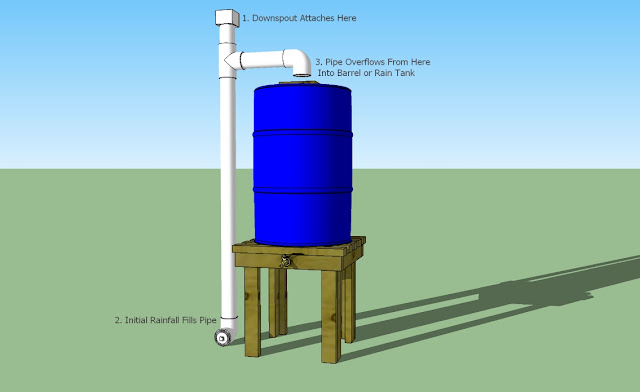
III. Where do I get a rainwater harvesting system? Many counties in the US have rainwater harvesting programs, and more counties are adding them all the time. Local offices offer rain barrel kits for the "do-it-yourself" type. Sarasota County sells 55-gallon drums, basic plumbing parts, and plans for a wooden stand, at a greatly reduced cost to consumers. You can also find rain barrels at many retail home supply stores, but these generally do not include a stand. A simple Internet search (of your area specifically) may provide you with several stores or local businesses that sell rain barrels or other rainwater harvesting systems.
IV. Irrigation Systems: Once you have decided on and installed your rainwater harvesting system, you might want to consider hooking up an irrigation setup, customized to work with your new rainwater harvester. If you plan to irrigate on a regular basis, an irrigation system will save you a ton of time and energy. There are several different types of components that you can use to create an irrigation system. Let's look at a few different options.
a) Sprinkler: Most large sprinkler systems tend to consume a considerable amount of the harvested rainwater each time they are used. If your only goal is to water your lawn, and you don't have tight constraints on how much water you use, this might be a good option to consider. However, if you are looking to conserve your rainwater, a traditional sprinkler system may not be the best option.
b) Soaker hose: Soaker hoses are designed for use with large amounts of water pressure. The water pressure you get from gravity-fed rainwater harvesting systems is not sufficient to supply a soaker hose without a pump. Therefore, soaker hoses are not often used with rainwater harvesting systems.
c) Drip irrigation: Drip (or micro) irrigation systems are a favorite of many rainwater harvesters for several reasons. Because of the smaller diameter of the pipe or tubing, and the smaller diameter of the emitters (sprinkler heads) drip irrigation systems usually consume far less water than other irrigation systems. They are custom tailored during installation to direct water only to the sites or individual plants where you want it. And, drip irrigation systems work with or without a pump.
Now, to address the second part of our topic, we have listed below several common applications for harvested rainwater.
Immediate Uses for Harvested Rainwater
1) Irrigation - flower beds, gardens, landscape features: trees, plants, shrubs
2) Water features - water gardens, koi ponds, waterfalls - rainwater is a great choice for these uses because it doesn't need the pre-treatment that municipal water requires to ensure the health of fish and plants.
3) Cleaning applications - many outdoor chores that require water can be accomplished using rainwater. We just cleaned the white-wall tires on the Ghia with our harvested rainwater!
4) Watering livestock - Cows, goats, sheep, chickens and other animals are often given rainwater on farms. Our chickens harvest their own rainwater from the gutters we installed on their coop!
5) Emergency situations - Harvested rainwater can be filtered and/or boiled for consumption in emergency situations. It can be used for flushing toilets, washing, cleaning laundry and cooking. Your harvested rainwater will be a coveted commodity!
We've even used rainwater to mix concrete.
These are just a few examples of immediate uses for harvested rainwater. There are many more, so be creative!
We hope this has been a helpful dialogue for the beginner or for those of you who may be on the fence about whether or not to harvest rainwater. Even if you think a rain barrel will not accomplish all of your watering needs, we think it's at least a good place to start. You can always add to your system over time!
We will go into further detail about much of the information presented here in future posts. In the meantime, please feel free to leave questions or comments.
Happy harvesting!
~Sarasota Rain Barrels