Showing posts with label sketchup. Show all posts

Tuesday, May 29, 2012

Pre-Filtration For Your Rainwater Harvesting System

We often get questions about how to filter the water that you capture in your rainwater harvesting system. Specifically, people want to know how to keep things such as leaves, shingle pebbles, dirt, and other debris from entering their rain barrels.

Today, we'd like to share a how-to tip with you on pre-filtration: how to design your system to filter the water before you start to collect it.

A good way to help reduce the debris that enters your rainwater tank once the water begins to flow is to add a first flush diverter (also known as a "roof washer") to your system. In addition to helping filter debris from the rainwater, a first flush diverter also helps to reduce the salinity of the harvested rainwater in coastal areas, where salt tends to get deposited on rooftops.

One of our favorite simple pre-filtration designs is called a stand pipe, which is one of the most cost-effective solutions. A stand pipe can be constructed from materials found at most retail home supply stores, and usually consists of 3-inch PVC pipe, two 90-degree elbows, one Tee fitting, a cleanout cap, and a downspout adapter.

Shown below is a SketchUp model we created of a rain barrel with a stand pipe.
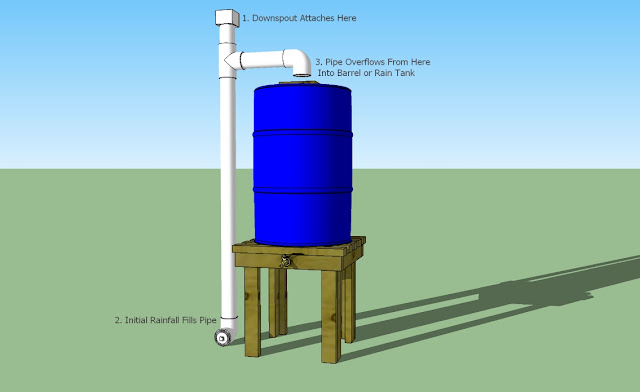
Here's how the stand pipe works:

1) The water enters the pipe at the top where it connects to a downspout.

2) The first water that is captured in the gutters from the roof flows down the stand pipe.
*The dirt, leaves, pebbles, and other heavy debris contained in the rainwater collect at the bottom of the pipe behind the cleanout cap.

3) The water fills up the stand pipe until it reaches the Tee fitting, which acts as the pipe overflow, and then begins to flow into your rain barrel, cistern, tank, or other catchment.

4) The cleanout cap, located at the bottom of the stand pipe, should be connected loosely to allow a slight leak. Letting the pipe slowly leak ensures that the pipe empties between rainfall events, so the next time it rains and you begin the process again, there is plenty of room for the initial water with the most debris to collect before entering your rainwater harvesting system.

Below is a picture that shows our 3-barrel system with a stand pipe.

This is just one DIY version of a stand pipe. There are many different types of first flush diverters that are commercially available in a variety of  shapes, sizes, and price ranges. We simply want to show you that adding a pre-filtration design to your rainwater harvesting system does not have to be costly or intimidating and can greatly improve the quality of the water before it even enters your tank.

Thanks for reading and happy harvesting!

~Sarasota Rain Barrels

Monday, May 28, 2012

Planning with SketchUp Models


Planning is an important part of any project. We plan each rainwater tank, rain barrel, rain garden, and cistern system to find ways to make each one more effective and efficient. Today we'd like to introduce you to one of our favorite planning resources: Google SketchUp. This powerful, free tool is easy to use once you learn the basics, and allows you to build a 3-D computer model of almost anything!

Creating a computer model of your project is "virtual practice." You'll be able to perfect your design before you pick up your first tool. And, you can calculate the amount of materials you will need, so you don't end up buying too much or end up short.

Below you can see the SketchUp model of a bridge we built for our rain garden.


Garden Bridge:

3D model by
Sarasota Rain Barrels

The picture below shows the rain garden bridge final product.


When you spend the time to complete a model before you start to build, you gain the confidence and knowledge that your project will turn out the way you have envisioned it. Plus, if you wish to produce more than one of your creation, having a pre-planned model makes replication a breeze. If you want to create different versions of the same concept, SketchUp has tons of cool features that let you to tweak your models before you start to build. You can see and toggle between the different variations so you can create the perfect set or individualized separates.

Below is a SketchUp model of a variation on our rain garden bridge.If you have an idea for your project, but aren't sure where to start, "thinking out loud" while you create a model is a great place to begin. Google's 3-D Warehouse has hundreds of thousands of models created by others that you can browse, download, and edit to make your own.  

SketchUp is also a great tool for your business. You can import and export images, add your company logo to your models, and transpose your models onto your presentation materials. And, you can print your model images for easy distribution.

If you haven't already, we recommend checking out Google's 3-D Warehouse. You will be pleasantly surprised to see how many fun and interesting ideas exist for all types of projects. While you're there, stop by to check out our rainwater harvesting systems and other models. Who knows? You might just get inspired to create your own!

We hope this information has been helpful. We'll be back soon with more tips, tricks, and information on rainwater harvesting and other fun outdoor and garden projects.

~Sarasota Rain Barrels